
FORCE Technology sees many cases of corrugated pipes in new construction with missing or poor grouting. As a result, the building does not achieve the intended stability. The error rate is up to 20%.
In many of the wall and column elements installed on construction sites, embedded corrugated pipes are used for inserting temporary timber formwork (also called continuity reinforcement or robustness reinforcement). The corrugated pipes are grouted directly on site with flowable mortar after the elements and timber formwork have been installed.
Increased quality assurance or severe frost can reveal errors
Poorly grouted pipes are often discovered late in the construction process, or sometimes not at all. This complicates and increases the cost of locating poor grouting and the subsequent remediation.
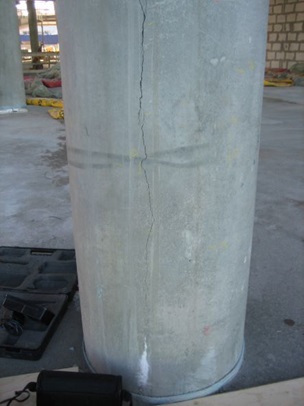
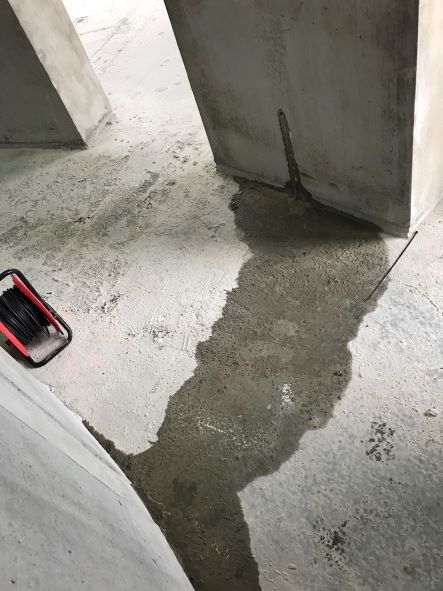
In some cases, errors are only discovered because the affected concrete elements have cracked due to frost damage, caused by wet mortar that does not harden or by water in the pipe. However, not all poorly grouted elements crack due to frost. If there has not been a long enough period of severe frost, or the elements are kept warm inside behind facades, these errors will not be detected.
In recent years, there has been a tendency for more construction projects to request examinations as part of quality assurance. Either because there is suspicion that errors may be present, or because the guidelines in Betonelement-Foreningens Bulletin 5 are being followed.
Quality control quickly detects problems and minimizes costly repairs
When errors occur, failure rates of up to 20% are not uncommon. The earlier errors are detected, the lower the risk that they will be repeated throughout the entire construction. This is the case when investigations are performed as quality control.
If the error is widespread throughout the project, it becomes both expensive and time-consuming to rectify. In addition to the costs of investigation and remediation, there may also be extra costs associated with finishing work.
Documentation should be required
Our experience shows that the quality of grouting in corrugated pipes should be documented. At the same time, a significant amount of money can be saved by conducting investigations much earlier in the construction phase.
As soon as the first pipes have been grouted and are expected to have cured, a spot check should be performed. In this way, errors in method selection, procedure, or product choice can be detected at such an early stage that the construction process is only minimally prolonged or made more expensive.
It is our assessment that insufficient grouting continues to occur on many construction sites in Denmark where no control is performed. This is worrying!
Non-destructive testing (NDT) can locate grouting errors
Poorly grouted corrugated pipes can be detected using, for example, Impact Echo or ultrasonic measurements. Both methods rely on the reflection of either ultrasonic or pressure waves.
The waves are reflected when there is a sufficient difference in acoustic impedance (density x sound velocity in the material), for example, at the transition between concrete and air. For a correctly grouted pipe, the reflection will occur at a depth corresponding to the back of the structure.
If there is a problem with the grouting of the corrugated pipe, it will be observable based on the reflections.
For a specialist, poorly grouted pipes in walls can be easily detected. Columns and composite elements can also be examined using these methods, provided there is knowledge of the reinforcement configuration and the element's geometry. In addition to locating poorly grouted elements, it is also possible to delimit defective areas on each element.
Get a damage assessment of corrugated pipes
During a damage assessment, we investigate why the damage occurred.
We perform a detailed review of the entire process: construction history, specification requirements, execution procedure, product choice, control, and in some cases, controlled experiments to replicate the error/damage.
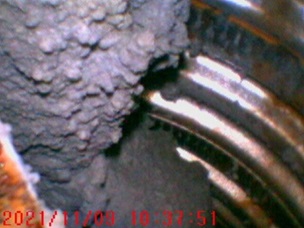
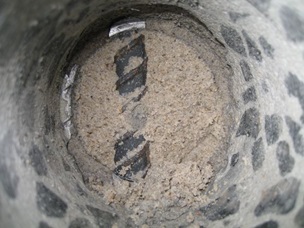
Finally, you receive a report describing the cause of the damage, or more commonly, a combination of factors that led to the issues, along with documentation of the investigation (including endoscopy images if requested).



Reach out to our expert Mette Steinlein Christensen for more infomation.