At regular intervals, the media reports that the incidence of legionella infections is increasing. But what is legionella, how does it spread, and how can you avoid legionella?
Cold and hot water are taken for granted
The supply of both cold and hot domestic water has become an integral part of building operations. As a starting point for the production of hot and cold domestic water, raw water is supplied from large waterworks. In Denmark, this raw water is often groundwater, which is typically of good quality.
However, changes in water quality may occur in individual buildings, for example, an unintended increase in bacterial content in the water. In the worst case, these bacteria can cause the water to pose a health risk to users.
Therefore, the operation and maintenance of domestic water systems should aim to minimize changes in water quality in each residence as much as possible.
Operation of cold water systems
There have only been a few reported cases where the growth of legionella in the cold water system has been significant enough to pose a danger to consumers. This is because cold domestic water usually has a temperature so low that the growth of legionella in this system is minimal.
If unintended heating of the cold domestic water occurs, for example due to shared insulation with the hot water supply, or if there are very long retention times in the system, there may be a rise in the bacterial content in the water, including the growth of the legionella bacterium.
Operation of hot water systems
Operating temperatures
To avoid legionella, the operating temperature in hot water systems during normal operation should not exceed 60°C and should not fall below 50°C anywhere in the system.
However, it should be noted that operating temperatures above 60°C can lead to the growth of thermophilic bacteria and increase the risk of scalding.
Retention times
The retention time in hot water tanks and reheating after peak usage should be adjusted so that the water temperature in the range 20–45°C is minimized.
The temperature at the outlet of the tank must not drop below 60°C during 20 minutes of maximum consumption.
As many hot water tanks are oversized, it should be checked that the retention time in the tank does not exceed 24 hours.
What is legionella – and how does it spread?
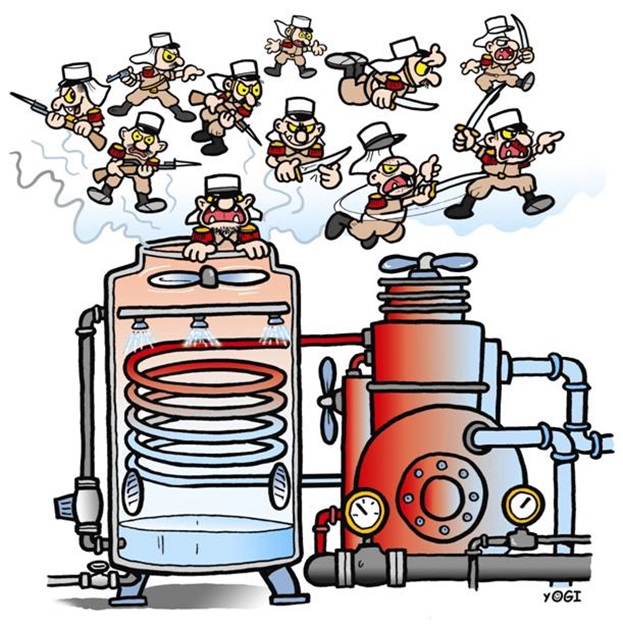
- Legionella is a group of bacteria, about half of which can cause infection (in particular, Legionella pneumophila serogroup 1 is aggressive).
- The Legionella bacterium multiplies in water, and moisture is therefore necessary for the bacterium to propagate.
- Legionella bacteria thrive best at 20°C – 45°C, and at temperatures above 60°C, the bacteria are killed.
- Legionella can only infect people if they inhale small water droplets – the so-called aerosols.
- When people become infected by Legionella bacteria, they may develop the so-called Legionnaires' disease, an influenza-like illness or pneumonia.
- Legionnaires' disease can be fatal for people with weakened immune systems – therefore, patients in, for example, hospitals or residents in nursing homes are particularly at risk.
Bacteriological Water Quality Control
For all extensive hot water systems, the bacteriological water quality should be checked at least once a year, and tests must include both total bacterial count and legionella bacteria.
If there is suspected or confirmed elevated bacterial counts, follow-up monitoring measurements should be carried out monthly to track the development until the bacterial count has dropped to an acceptable level.
Samples should be taken at locations where the risk of bacterial growth is greatest, such as:
- At rarely used taps
- At long branch pipes without circulation
- At showers
- At taps used by immunocompromised individuals (in hospitals, nursing homes, etc.)
Normally, 2-3 samples are taken in special sampling bottles and sent either to Statens Serum Institut or another laboratory capable of performing the analysis.
Other Systems at Risk of Legionella
Above, we have provided examples of how the operation of cold and hot domestic water systems can be organized to minimize the risk of legionella. The focus has only been on the operation of the system, but it is also possible to minimize the risk of legionella growth through system alterations, such as removing dead pipe ends, etc.
Legionella in Other Humid Environments
As mentioned, legionella can be found in any humid environment, so it is not only in domestic water systems that people can be exposed. For example, cooling systems, fountains, and spas have proven to be areas where legionella growth can become so extreme that it poses a risk to people exposed to aerosols from such a system.
Operation and Maintenance Reduce the Risk
For cooling systems, fountains, and spas, sensible operation and maintenance of the systems can also help minimize the risk of legionella growth.
For more detailed recommendations on how to avoid legionella in domestic water systems, please contact FORCE Technology.
Related insights

Legionella in domestic water systems

Temporary Insight Page For Set-Up
- All articles and casesOut for some inspiration. Go have a look at some of our interesting cases and articles.

Reach out to Søren Klinggaard for more information.