
Use Total Cost of Ownership (TCO) instead of only considering the purchase price when investing in production equipment for food manufacturing – there are significant resource savings to be gained.
Long-term investment requires professional assessment
Buying a car is often a long-term investment, where a number of evaluations and comparisons are made before making a purchase. If you are not sufficiently competent yourself, you often consult someone who is. Thus, an assessment and comparison is made of the various parameters that can be found for the selected vehicles (fuel, consumption, expected mileage, repair costs, taxes, safety, etc.).
Then you choose the best car for your needs – which is not necessarily the cheapest car. Without even realizing it, you are using a form of Total Cost of Ownership – TCO – to determine which car to invest in.
Purchasing equipment, like a car, is a long-term investment that should include a professionally competent assessment – that is, a calculation of Total Cost of Ownership (TCO). The price assessment should be approached with a more nuanced evaluation than just the "purchase price," so that the total operating costs are also considered before buying. But does your company’s purchasing department have these competencies?
What is Total Cost of Ownership - TCO?
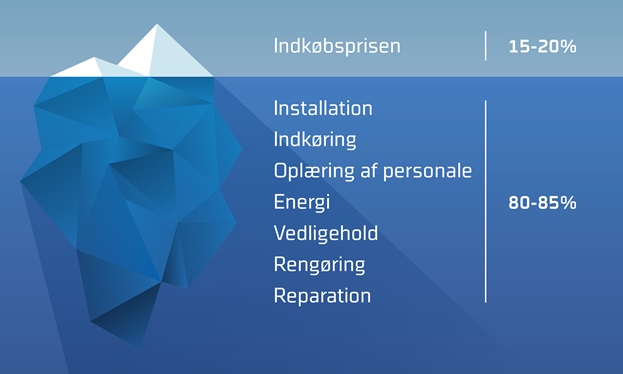
TCO can be seen as an iceberg – which, as is well known, is largest below the surface (80-85%). The purchase price can be considered the "tip of the iceberg" – an amount corresponding to 15-20% of the actual TCO, while all other operating expenses amount to around 80-85% of the real TCO.
Collaboration ensures the right equipment
A major part of the challenge is that, in many food companies, it is the purchasing department that buys equipment. Their competencies often lie outside the core expertise required for production, product quality, microbiology, materials, cleaning, etc. As a result, important elements can be overlooked in both the specification and/or the calculation of TCO.
Strong recommendation: Educate and actively use staff throughout the process – in this way, all aspects are considered before buying equipment. This ensures that you invest in the right equipment and do not later discover “whoopsies” that can be very expensive to fix. No one can be an expert in everything – everyone has their specialized skills – but it's important to use them correctly. This can directly affect the bottom line.
TCO and cleaning – the importance of hygienic design and resources used in cleaning
Small changes in hygienic design can mean that production equipment is much quicker to clean. It is important to consider hygienic design as a whole. Below are just a few of the hygienically critical hotspots that are often seen in equipment:
- The state of surfaces (cracks, crevices, pitting, etc.) and roughness – also on used equipment
- Joints, angles, and curves, especially where there is product contact
- Drainability, where items that are tilted are easier to clean and can be drained
- Accessibility of the equipment – it's quicker to keep clean when it’s easier to access.
When the hygienic design is improved, the calculated TCO will also improve, as resource savings are achieved in cleaning.
5 minutes saved a day – does it matter?
When working on optimization in cleaning, it is always extremely important to maintain a strong focus on cleaning quality, ensuring there is no gradual decline in results from cleaning validation. It is also crucial to consider where and what is tested in cleaning validation, so that the correct parameters are included.
Example of gain with shorter cleaning time
When doing the math, 5 minutes less cleaning per session may not sound like much – but over just one year, with production running (only) 5 days per week, this results in an additional possible production time of more than 21 hours per year.
If you consider larger production sites, for instance with 24-7-365 operation in closed production systems, with a production cycle of 10 hours and 2 hours cleaning, a saving of just 5 minutes on cleaning time gives an annual benefit of 61 extra hours of possible production per year.
This is only the time saving; in addition, there will be savings from reduced consumption of water and cleaning chemicals. The valuation of extra production hours depends on what it costs to produce one extra hour – versus what can be earned – if it’s a net positive, it's good business. In such cases, having this extra production time can result in a significant increase in earnings.
Be careful about reducing cleaning time
If the production setup has trouble keeping up with demand, there is a risk that cleaning – by those inexperienced in contamination risks and microbiology – will be seen as "wasted time,” and cleaning time will be reduced uncritically. Be careful with this. In many productions, cleaning can indeed be optimized thoughtfully, so that with a few design changes to the production equipment – better hygienic design – and potentially changes to work procedures, the same cleaning quality can be achieved in less time.
Example: Results from field trials – same cleaning quality – significant resource savings
The above considerations are just theoretical examples. By optimizing hygienic design, processes, and procedures, a field trial in the food industry achieved significant savings in resource usage for the cleaning process. After a year of these changes, cleaning validation results are still under control.
The field trial resulted in resource savings in both time, water, and cleaning chemicals. Thus about 9% less time was spent on cleaning, between 14-17% savings in water usage, and approximately 5% savings in cleaning chemicals.
The time savings mean that there is now capacity to increase production time. As a result of the recently announced verdict regarding the tax base in the water sector, savings in water consumption also have great economic importance.
The field trial made it clear that when there is an understanding of each other's workflows and processes, and when good and visible leadership works, it is easier to maintain the small daily resource savings in the cleaning process. It is important to point out that it is not just about "running faster," but doing things thoughtfully and with care. Only in this way can cleaning validation results be kept under control while saving resources.
A few minutes saved each day adds up over the year to tangible savings in cleaning time, less consumption of water and cleaning chemicals. This leads to an improved bottom line.
The article is written by Annette Baltzer Larsen, FORCE Technology and Kim Petersen, FoodSafe, and was published in the magazine Plus Proces No. 4 2018
Research and development
In the project: “New cleaning strategies in the food industry: Increased uptime and high food safety,” FORCE Technology is developing a "safety window" for selected corrosive chemicals (disinfectants) used in cleaning procedures. Based on this window, it can be assessed, among other things, whether disinfection at a higher temperature for a short period of time can be used without an increased risk of material corrosion.
Additionally, FORCE Technology is working on hygienic design and opportunities for continuous decontamination of specific hot-spot areas. An advisory group is associated with the project, following the project and its results. Moreover, the advisory group also serves as a network for participating companies.
Read more about the project or contact Annette Baltzer Larsen for further information.





Reach out to Annette Baltzer Larsen for more information.