
Articles
How can motorway noise be reduced?
Covering motorways can significantly reduce road noise and better connect urban areas. There are many solutions, including both transparent and non-transparent coverings and barriers.
Less noise provides better quality of life, but lack of space
The large motorways, particularly in the metropolitan area, cause significant noise pollution for the residential areas located alongside them.
There are several examples where both the affected residents—and increasingly also politicians—wish for actions against traffic noise issues. Residents want better living conditions with less noise, both in their homes and nearby outdoor areas.
However, the noise zones around the motorways mean it can be challenging to find new available land for urban development that is not already burdened by noise levels above the Environmental Protection Agency's recommended limits. This restricts the development opportunities for several municipalities.
Advantages of motorway covering
- Significant or complete noise reduction
- Two urban districts can be connected by recreational areas and pathways instead of being divided by a motorway
- New areas for sports facilities and recreational spaces
- Construction of new housing etc. above the covered areas
- Building on areas along a motorway that were previously so noise-burdened that construction was impossible
- Integration of electricity-producing solar panels as part of the cover
Covering presents both challenges and opportunities
In recent years, the capital municipalities—especially in the western suburbs of Copenhagen—have focused on an opportunity previously overlooked or quickly dismissed: whether it is possible to fully cover motorways—or at least those stretches causing the most noise in local areas.
The immediate counterargument has been that such covering is both technically very challenging and economically unfeasible.
To qualify the discussion of covering solutions, this article presents several international examples where full or partial covering has been used to reduce road noise. At the same time, covering has enabled new uses for the areas that have been acoustically relieved.
Covering the motorway through Tårnby created green areas
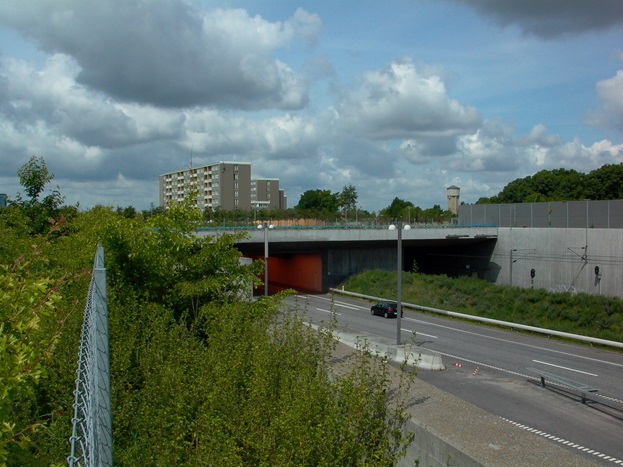
The first example is Danish and comes from Tårnby. During the construction of the Øresund Link over 25 years ago, a new motorway segment was built which cut through some residential areas in Tårnby Municipality. On one stretch, the motorway passed close to four seven-story apartment blocks, which would have been exposed to high noise levels.
The solution was to cover about 700 meters of the motorway with a concrete deck. The covering provided a significant noise reduction for the apartment blocks. Moreover, green recreational areas were created on top of the concrete deck, ensuring the motorway did not divide the urban area in two. Instead, the district was united around these green spaces.
The project was funded as part of the entire Øresund Link land works.
Covering the A7 in Hamburg enabled new housing development
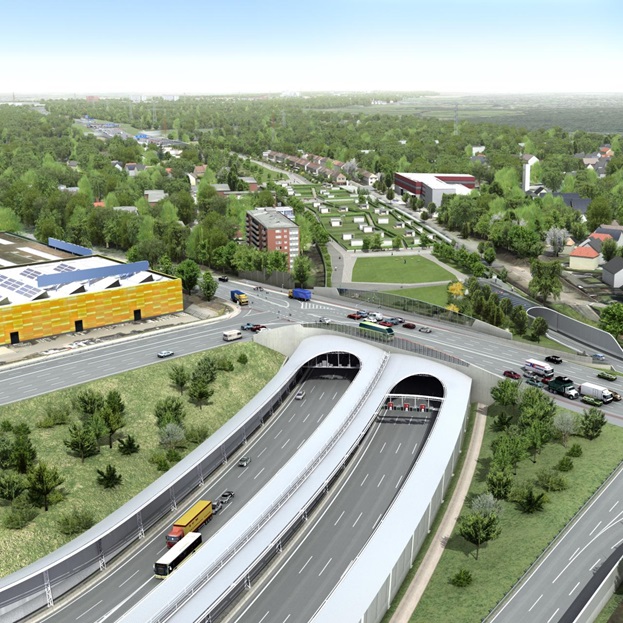
Motorway A7, which leads traffic north out of Hamburg, has for years had three lanes in each direction. Parts of the road pass close by residential areas that are heavily noise-polluted (read more).
Additionally, there are undeveloped plots along the road, which due to noise cannot be urbanized. Work is underway to expand the road by another lane in each direction.
Noise reduction is a priority part of the project, and it has been decided to cover a total of 3.6 km of motorway with a concrete deck. In this significant way, most of the traffic noise on these stretches will be eliminated.
This solution has several advantages:
- Many existing homes will have their noise exposure significantly reduced
- New and "noise-free" green spaces will be created
- The two urban districts on either side of the motorway are connected with new green spaces and path networks established above the covered areas
- Areas previously impossible to build upon due to noise can now be used for new housing; the sale of building plots can partly finance the cover
Transparent cover in Melbourne created peace in the apartment block
Outside Melbourne, Australia, a brand new six-lane motorway was planned, partly routed on a bridge over existing roads and large green areas.
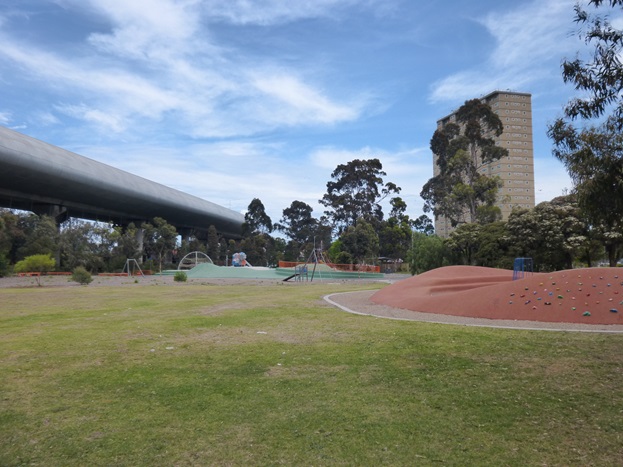
On one stretch, the motorway passes close to a 19-story apartment block, which would have suffered high noise levels without substantial noise protection. The authorities thus required noise shielding.
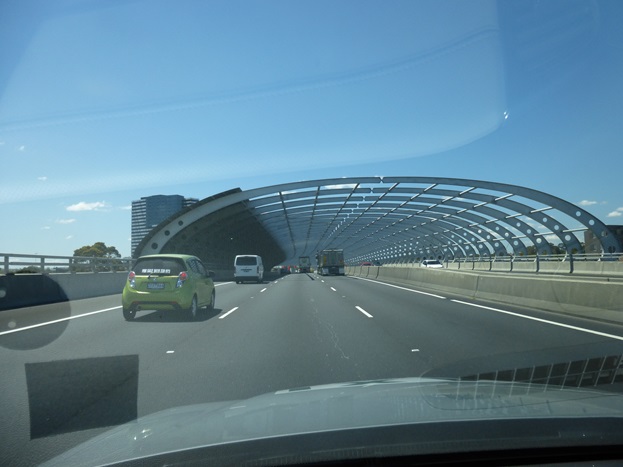
The private company responsible for building and operating the toll motorway decided to cover it with a lightweight construction using partially transparent elements. The chosen solution—The Melbourne Noise Tube—has several advantages:
- The apartment block receives effective noise protection
- Large outdoor spaces along the motorway enjoy significant noise reduction and can continue to serve as attractive recreational areas for residents
Solar panels reduce noise and generate income
In Germany and Austria, there is an experimental project where solar panels are installed as roofs over motorways (read more). The aim is to reduce noise for the surroundings. At the same time, the electricity produced can be sold. The proceeds can be used for project financing, for example to repay loans taken out to realize the project.
Today in Denmark, some land is used for installing solar panels to produce electricity. This often presents an aesthetic challenge and takes up land that could be used for agriculture or recreation. If solar panels could instead be integrated into road coverings, it would free up land for other purposes.
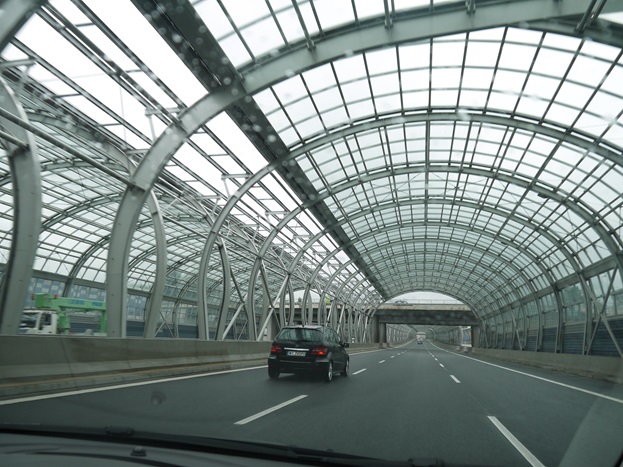
Transparent cover in Poland with mid-ventilation
Motorway S8 in Warsaw passes very close to the city district of Bródno, which contains many apartment buildings. To achieve significant noise reduction, a 1200-meter section of the motorway has been covered (read more).
The cover is a lightweight steel structure with transparent glass panels. No glass panels are installed in the center of the roadway to allow for ventilation and fresh air in the covered section. Emergency exits are established every 200 meters on both sides.
Solutions for noise problems
Many solutions are continuously discussed in the public and technical debate, such as:
- General speed reduction on stretches passing dense residential areas
- Speed reductions at night
- Restrictions on heavy traffic, e.g., at night
- Use of noise-reducing road surfaces like porous asphalt
- Introduction of quieter tires
- Installation of noise-reducing guardrails
- Installation of new and raising of existing noise barriers and embankments
- Use of local noise barriers to shield primary outdoor areas at homes
- Creation of "noise-free" oases in noise-polluted urban areas
- Use of noise-insulating window and facade solutions
- Covering
Many types of covering in Paris
It is not new that urban planning has considered covering motorways and separating the noisiest traffic from pedestrians, cyclists, residences, and businesses.
During the planning and construction of the Paris district La Défense in the 1950s and 60s, the through motorways were carefully laid out to minimize their nuisance to the new district.
Boulevard Périphérique is the heavily trafficked ring motorway in Paris. In many sections, it is covered to limit noise problems. In some places, a lightweight cover has been used, which cannot be walked on—much less built on.
Elsewhere, the cover consists of a concrete deck, on which recreational areas and football fields have been created. There are plans for covers with high-rise buildings on top. Here, selling the building land can fully or partially finance the cover.
Noise control benefits both public health and the economy
Covering a motorway is a visually significant intervention with major influence on the urban environment. Therefore, it is important to involve expertise in urban and landscape architecture in the planning process.
Along, for example, the Køge Bay and Hillerød motorways, there are for long stretches up to 100-meter-wide strips on both sides to ensure distance to noise-sensitive housing. If a "lid" was placed over the motorway, these large areas could be used for urban development. The sale of these areas could help finance a cover.
In future projects, one could consider using electricity-producing transparent solar panels instead of ordinary glass. The revenue from selling electricity can be used as part of the repayment of the cover.
Today, motorway noise has become a major focus as a negative effect that disturbs many people and even makes some seriously ill. There is thus a basis for adopting a more holistic view of noise abatement and motorway planning. For example, the socio-economic costs of motorway noise should be given more weight than in the past. This may bring more expensive solutions into play in the fight against noise.



Reach out to our expert Per Finne for more infomation.