
The Danish recommended noise limit from roads is currently set at Lden = 58 dB for dwellings along urban roads and motorways. This corresponds to approximately 10% of the population being highly annoyed by the noise.
FORCE Technology has conducted an international literature study for the Danish Environmental Protection Agency, which wanted updated knowledge. It is concluded that various studies support the Danish noise limit of Lden = 58 dB for regular roads/urban roads. It is also concluded that several studies show that motorways are more disturbing at the same noise levels than other roads. A Swiss study suggests that 10% are highly annoyed by motorway noise at Lden = 51 dB. Studies from the Danish Road Directorate indicate Lden = 52 dB for 10% being highly annoyed.
Motorway noise is more disturbing than noise from urban roads
A new study published by the Danish Environmental Protection Agency indicates that residents along motorways are more disturbed by the noise than residents by urban roads at the same noise level. The difference can be quantified so that motorway noise needs to be 6 dB lower to be perceived as equally disturbing as urban road noise. The study also shows that the Danish recommended noise limit for road noise works correctly with respect to no more than 10% being highly annoyed.
The Danish recommended noise limit for road noise is currently set at Lden = 58 dB for dwellings along urban roads and motorways. This should correspond to about 10% of the population being highly annoyed by the noise. However, two analyses/reports—one by WHO [1] and one by the Danish Road Directorate [2]—question whether this limit is correct if it is meant to equal 10% of the population being highly annoyed. For example, the Danish Road Directorate study shows that the annoyance effect at 58 dB is higher for motorways than previously assumed—i.e., more than about 10% are highly annoyed. The WHO report from 2018 generally shows that the annoyance effect from roads is greater than assumed for the Environmental Protection Agency’s set limit value of Lden = 58 dB, and the report recommends a limit of 53 dB. WHO considers 10% highly annoyed as a relevant risk increase to use as a basis for setting limit values.
New international studies on noise annoyance
The Danish Environmental Protection Agency will not normally change its limit values based on one or a few studies. Therefore, the Agency wanted updated knowledge on scientific studies and reports about noise annoyance from road traffic. On this basis, FORCE Technology prepared a technical note "Annoyance Effects of Road Traffic Noise—a Literature Study" [3] for the Agency. The task included investigating what newer Danish and international studies exist that generally deal with annoyance due to road noise, and whether there are studies showing that motorway noise has a different dose-response curve than urban roads.
Only two recent studies were found—one from Denmark (Danish Road Directorate studies incl. [2]) and one from the Swiss SIRENE project. Relevant data were also found and cited from reports and literature before 2014.
Noise annoyance from roads in general and urban roads
The WHO report from 2018 [1] is based on a wide range of noise annoyance studies, but if unrepresentative studies are excluded—as additionally done in the background article for the WHO report on noise annoyance—a noise limit of Lden = 58-59 dB is found for 10% being highly annoyed, which does not differ significantly from the Danish limit.
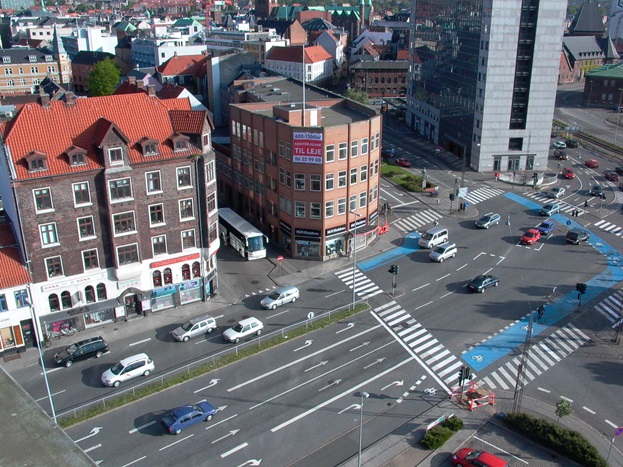
The Danish Road Directorate's two surveys from 2007-2008 and 2014 [3, 4, and 5], which include urban roads with 6,188 respondents in total, provide results that support the current limit value. A Swiss survey with 5,364 respondents from 2014-2017 shows that 10% are highly annoyed at a noise level of Lden ≈ 58 dB, thus also supporting the Danish noise limit.
Noise annoyance from motorways
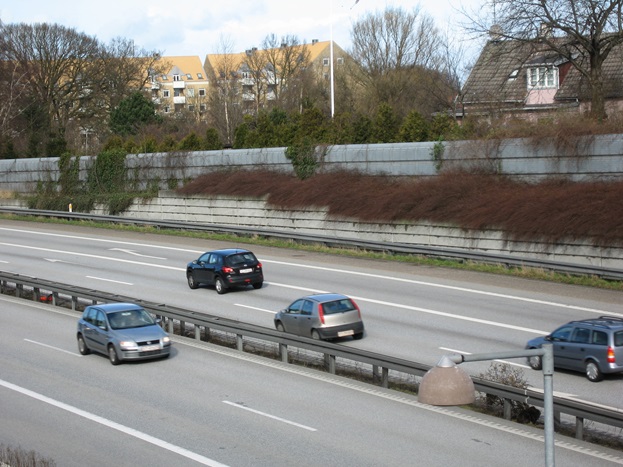
A couple of early studies from before 1992 [7] show that motorway noise is more disturbing than noise from other roads—by 5 dB or more. The Danish Road Directorate’s survey of 3,444 respondents from 2014 [2] with representative Danish motorways shows that noise from the motorways is more disturbing than noise from urban roads. The survey shows that at 52 dB, 10% are highly annoyed by motorway noise.
The Swiss study with 5,364 respondents from 2014-2017 shows that roads with motorway-like noise character—that is, relatively constant noise without pauses—are about 7 dB more disturbing than roads with scattered traffic and pauses at the same noise level.
Conclusions
The conclusions are:
- Various studies, including the WHO report’s background article, support the Danish noise limit of Lden = 58 dB for regular roads/urban roads.
- Various studies show that motorways are more disturbing at the same noise levels than other roads. A Swiss study suggests that the noise limit for motorways should be around 51 dB. Danish Road Directorate studies point to a noise limit of Lden = 52 dB for 10% being highly annoyed.
Authors who contributed to the WHO report recognize in an article the standardized annoyance curves as a step forward for implementing evidence-based policy at both national and supranational levels. However, they do not believe these general curves are suitable for conducting impact analyses on a smaller scale, such as regional, municipal, or project level. In this light, it is recommended to use the results found in the Road Directorate's studies, which involve many thousands of Danes living in homes close to roads representing Danish conditions. This applies both to urban roads and motorways.
It is important to note how much more disturbing motorway noise is perceived. This should be considered in socioeconomic assessments, such as when setting noise indicators and noise limits.
References
1.World Health Organization (WHO), 2018. Se: www.euro.who.int
2.Rapport 551 – 2016, Vejdirektoratet. Se: www.vd.dk
3.Genevirkning af vejtrafikstøj – et litteraturstudie. Teknisk Notat fra FORCE Technology 27-1-2021. Se: www.mst.dk
4.Rapport 447, 2013. Vejdirektoratet. Se: www.vd.dk
5.Report 187, 2010. Vejdirektoratet. Se: www.vd.dk
6.Rapport 442, 2013. Vejdirektoratet. Se: www.vd.dk
7.Arbejdsrapport fra Miljøstyrelsen nr. 1, 2013. Se: www.mst.dk



Reach out to Per Finne for more information.