

By Morten Kjær Johansen, Senior Specialist, FORCE Technology

The development and marketing of medical devices is highly regulated and many pitfalls exist, potentially complicating and increasing costs. Here are 3 key questions to begin.

As a test house, FORCE Technology is seeing a growing demand for accredited approvals. The increasing demand clearly demonstrates that requirements are tightening, and the control functions are working as intended.

For manufacturers of medical devices it is important to notice that the regulation is not simply a 'bad thing'. The regulation helps keep the market free of unacceptable - at times dangerous - products by setting the bar high for approved marketing. At the same time, the relevant standards contain excellent process-oriented methods that ensure the efficient execution of development projects with a few reversals.

The best approach to regulation and standards is to strive to achieve compliance from the outset of any development project. All too often, companies experience a relatively heavy burden of backlog in the form of lacking documentation, incorrect labelling, lack of security mechanisms, etc., and the result is increased costs and delays as a result of necessary updates and the need to repeat costly accredited tests.

3 central questions

Initially, any manufacturer of medical equipment should ask a number of clarifying questions:

  • What is the intended use of the product? (Curing of a disease? Remedial treatment, relief or monitoring, examination of a specific disability? Contraception? On which body part is the product to be used?)
  • Who should use the product? (Gender, age, demographics, disability and any restrictions. Consider these for all user groups - installers, healthcare assistants, relatives, patients, etc.)
  • Where is the product to be used? (at home, in hospital, in home care, during transportation, in emergency vehicles, on aircraft, helicopters, etc.)

These are very important questions. Let's go through them one at a time.

Risk and safety management medical devices
The quality of medical devices can mean the difference between life and death. Therefore, there are many regulatory requirements for development and marketing.

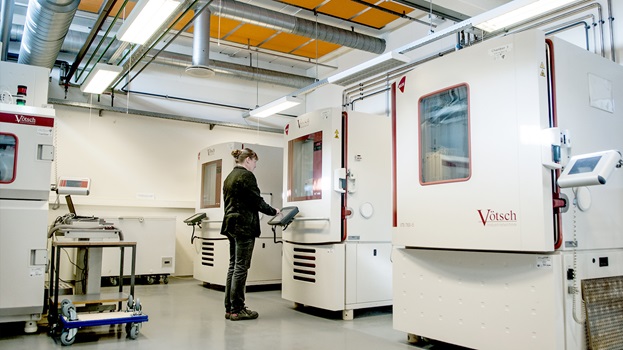
Test in climate chamber at FORCE Technology
A climate chamber test exposes the product to moisture and temperature fluctuations.

3 questions

The intended use forms the basis for classification as a medical product. It is imperative that the classification is in place early on, as an elevated medical classification may place additional requirements for the underlying development processes, product requirements and documentation. The classification is made on the basis of the “intended use” and the communication with which the product is promoted.


It is essential that the intended use and communication are consistent. As an example, the difference between the statements “The chair supports the lower back” and “The chair supports people with problems in the lower back” will determine whether or not one is dealing with a medical product.


When describing the intended use as a manufacturer, one should clarify how one specifically aims to prove that the product actually works according to its intended use. Therefore, it should be ensured, as far as possible, that the intended use is formulated in a measurable form, since the effect of the product must be shown in the form of a clinical evaluation - e.g. in user trials before marketing.


The clinical evaluation includes literature studies on the effect of similar products as well as analysis and assessment of which safety factors have played a role in other similar products. It may be unlawful to market non-state-of-the-art medical products whose deficiencies when compared to competing solutions pose an increased risk to the user.


On the flip side, there is obviously very little advantage in studying competing solutions or the safety-related conditions of competing solutions, as one’s own design is largely complete, and incentives for improvement are therefore typically very limited. Some companies choose to enter the market with the anticipation of an update in the near future. They often don’t realise that an update may very well require renewed approvals and updating of large amounts of documentation. It is highly recommended to adhere to the standards for User-friendliness (IEC 60601-1-6 / 62366-1) and EN ISO 14155-1 regarding clinical study, partly to ensure compliance with the standards, but more importantly to plan and streamline the development process and ensure that all relevant data is collected as early as possible for the safety and quality of the product.


Remember

In the risk management process the manufacturer must identify and document the characteristics of the operation, which may pose a safety risk as a result of both normal and accidental use.  

(See IEC 62366-1:2015 Cl. 5.2 & DS/EN ISO 14971:2012)

Different risks

The standard for general requirements for safety and essential functional characteristics points to approx. 130 different potentially relevant risks that need to be addressed in order to be approved.

(See DA/EN 60601-1/A1:2013, Ed. 3.1)

Requirements for labelling

User manuals and labelling for electrical medical products for home use should assist users with an education limited to 8 years. 

What are the life science industry’s biggest technological challenges?

New report maps the technological challenges with digitalization and green transformation in life science companies.

Related insights

Reach out to for more information.

Get in touch

Please do not write any personal or sensitive information in the message field. Further information about your personal data and your rights is contained in FORCE Technology's data protection policy. You can request data deletion by contacting FORCE Technology.