Challenge
CHEXS needed to verify the optical quality of their X-ray mirrors for hospital use.
Solution
FORCE Technology found an alternative validation method instead of investing millions in measurement equipment.
Result
CHEXS received outstanding validation data and is saving both time and money in their development project.
From space technology to X-ray rooms: CHEXS has succeeded with its X-ray mirrors at the European Space Agency (ESA). Now the technology is set to improve hospitals’ X-ray diagnostics.
CHEXS sees an opportunity to expand its business
100,000 X-ray mirrors. That’s how many mirrors will be mounted in a lens structure in a giant new X-ray telescope, which the European Space Agency (ESA) will use to explore black holes in space. The company CHEXS, which originated from DTU Space, has assisted ESA in the development of X-ray mirrors and is a consultant for ESA in the industrial production of the many mirrors.
Now CHEXS, which stands for Center for High-Energy X-ray Systems, is working to expand its business into optics for medical X-ray imaging.
“Our X-ray mirrors are designed to remove unnecessary wavelengths from the X-ray beam so that patients are exposed to less radiation, while also improving the quality of X-ray images,” explains Sonny Massahi, PhD and CEO of CHEXS.
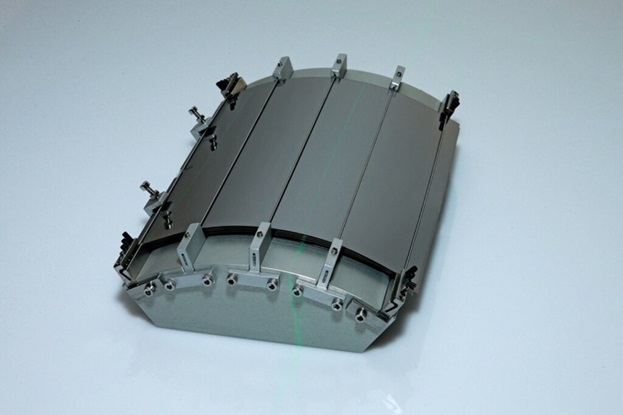
From space technology to medical imaging
The journey from space technology to medical imaging requires changes in CHEXS’ production setup. This also means new requirements for testing and validating both the production methods and the manufactured mirrors.
CHEXS would have to invest DKK 10 million in new equipment to verify that the manufactured mirrors meet the necessary optical quality for the new applications. However, in a MADE Material demonstration project, CHEXS and FORCE Technology identified an alternative validation method involving measurements at an international research facility.
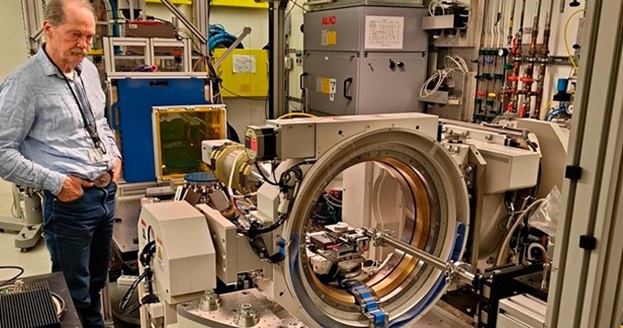
German quality check demonstrates performance
CHEXS measured their mirrors at the PETRA III facility at DESY (Deutsches Elektronen-Synchrotron) in Hamburg.
PETRA III is a synchrotron—that is, a facility where electrons are accelerated in a circle about 2,300 meters in circumference at nearly the speed of light. The electrons emit extremely powerful X-rays—exactly what is needed to validate X-ray mirrors.
The measurements are carried out using a technique called X-ray reflectometry, where X-rays are reflected off the surface of the mirror. The reflected beam is measured with an accuracy of 1/1000th of a degree, and the data from the measurements demonstrate the mirrors’ performance.
Our X-ray mirrors are designed to remove unnecessary wavelengths from the X-ray beam so that patients are exposed to less radiation, while also improving the quality of X-ray images.
Sonny Massahi / PhD and CEO of CHEXS.
Millions saved on laboratory equipment
The method yielded validation data of outstanding quality. It also eliminated the need for CHEXS to procure its own equipment, which shortened the product validation time and saved the small startup the investment of DKK 10 million.
“The precise data have subsequently made it possible to transfer the results to a less advanced setup in Denmark, where we can now perform the measurements and thus save further resources,” says Sonny Massahi.
After delivering specialized equipment to ESA satellite missions for years, CHEXS is now one step closer in its journey to transfer advanced space technology to practical applications in X-ray rooms on the ground.
Related insights

CHEXS sparer 10 mio. til måleudstyr til røntgenspejle

Temporary Insight Page For Set-Up
- All articles and casesOut for some inspiration. Go have a look at some of our interesting cases and articles.

Reach out to Torben Haugaard Jensen for more information.