
By Per Finne, FORCE Technology and Jakob Fryd, Danish Road Directorate
Since the year 2000, Denmark has used the same data basis for traffic noise calculations. After 20 years, it is therefore relevant to examine whether it is still fully suitable.
The Danish Road Directorate has long had a desire to investigate whether the source data (i.e., core values) used for noise calculations in Denmark are still representative of current traffic. The prevailing source data are based on measurements taken around the year 2000. Therefore, after more than 20 years of use, it is relevant to take a closer look at whether they are still fully appropriate as the basis for road traffic noise calculations in Denmark.
Why is it important to know the noise level of cars?
For our health, it is crucial that we keep traffic noise under control—both to minimize disturbances and to ensure that noise levels do not exceed what is considered safe. That is why noise calculation methods play a central role.
Since the 1980s, close Nordic collaboration has helped us continuously develop more accurate and nuanced noise calculation methods. Ultimately, these methods are based on well-documented measurements of both traffic and industrial noise.
This is how we calculate road noise in Denmark
Denmark uses the Nord2000 method as the standard for calculating road noise. The method is used both for large nationwide noise mapping and for more detailed calculations—for example, to determine the noise level at a specific residence. The calculation results are used, among other things, to assess how many homes are affected by noise. Often, it is the calculation that determines whether the Danish Environmental Protection Agency’s limit of 58 dB is exceeded, and whether noise barriers or other solutions are needed. Therefore, it is crucial that the calculations match actual conditions.
The Nord2000 method is based on two models: one that calculates how much noise is generated directly on the road, and one that calculates how the noise spreads to the surroundings—depending on wind, weather, terrain, and so on. The accuracy of the results depends especially on the input data and their quality.
The strength of the source, that is, how much noise is emitted, is calculated, among other things, based on average daily traffic volumes, shares of light and heavy vehicles, and actual average speeds. Pavement type also plays a role, since the contact between tires and pavement greatly affects the extent of the noise.
Knowledge about noise from different vehicle types, at different speeds, and on different pavements is based on many thorough measurements along Danish roads. These data form an important part of the noise calculations.
The Nord2000 method provides precise calculations—but can be hard to grasp
When Nord2000 was introduced in 2007, it provided a method that, on a significantly more detailed basis than before, could calculate traffic noise. At the same time, the noise indicator Lden was introduced, which in practice makes it more difficult to measure traffic noise directly and compare it with Lden (see fact box: DAY-EVENING–NIGHT LEVEL).
The reason for this is that the results must show average conditions over a whole year regarding wind, weather, and traffic. This does not make the results less reliable, but makes them more challenging to understand.
Control measurements examine changes in car noise
It is important that the source data forming the basis of calculations are accurate. That is why, over recent years, we have continually checked source data for cars, for instance by comparing the original data with new measurements from the Danish Road Directorate.
The measurements have been carried out either to check the noise from new asphalt pavements or to monitor developments in the noise properties of existing pavements over time. Some test stretches have been monitored for several years.
SPB measurements compared with Nord2000 calculations
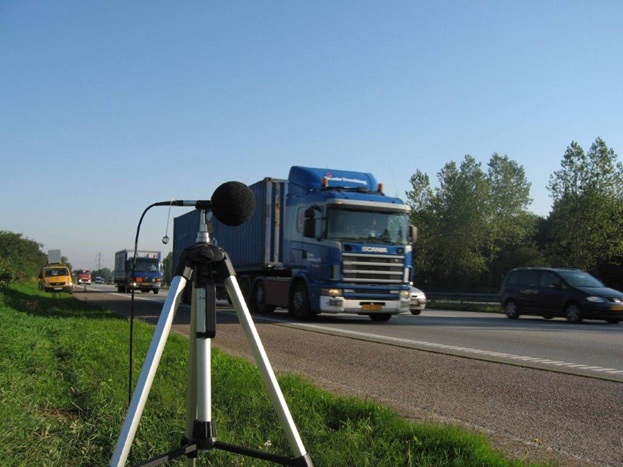
The measurements are conducted as so-called SPB measurements (Statistical Pass-By). Here, the noise is measured close to the road, as a large number of randomly passing cars go by (see fact box: SPB MEASUREMENTS). The measurement results can then be directly compared with what the Nord2000 method calculates—and thus we can assess whether car noise emissions have developed over time.
Drawing valid conclusions requires both many vehicle passes and measurements at several locations, since noise depends on both vehicle type, pavement type, and especially the vehicle’s speed at the site.
Most commonly, we measure at 80 and 110 km/h for passenger cars and at 80 km/h for trucks. In the calculations, we assume that the pavement is on average 8.5 years old to avoid overestimating the effect of brand new asphalt.
The type of tire also influences the noise. It is not possible to test every single tire type at the Danish Road Directorate, and therefore the average from many cars is used to balance out the variations. The statistical method ensures that the average noise level for different vehicle types is used in the calculations.
Do measurements reveal changes in car noise?
The graphs in Figures 2, 3, and 4 show the average noise per car depending on the age of the pavement. The black dot marks the result from the Nord2000 calculation, while dots in other colors show measurements from different locations.
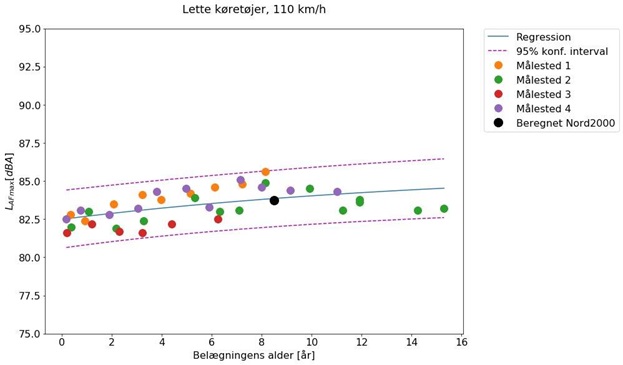
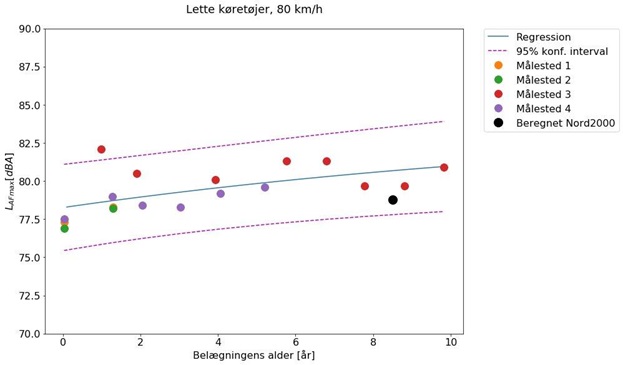
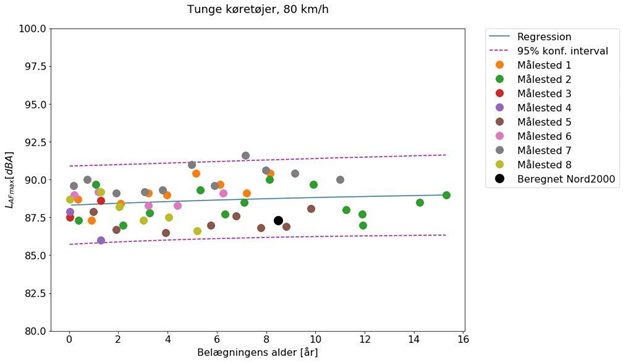
In all cases, we look at the reference pavement SMA 11 (stone mastic asphalt with a maximum grain size of 11 mm). The results are shown as maximum noise level, LAFmax, during passage, corresponding to the SPB measurement.
At the same time, the calculated value based on Nord2000’s current source data is shown. The solid line marks the average from the measurements, and the dashed lines indicate the 95% confidence interval for the upper and lower limits.
If the Nord2000 result is above or below the confidence interval, the difference to the measurements is significant.
Noise from light vehicles
Light vehicles include passenger cars and vans under 3.5 tons.
Figure 2 shows that calculations for passenger cars at 110 km/h are at the same level as the measured results. The few results for pavements older than 10 years are, however, a bit lower—therefore, we want more measurements before drawing conclusions.
On highways (Figure 3), we see that both the data volume is lower and that the calculated noise is on average 1.2 dB below the measurements. However, the difference is not significant.
It is also worth noting that data for pavements more than 5 years old cover only one measurement location. We would therefore like more measurements to assess whether there has actually been a shift compared to the approx. 20-year-old data.
Noise from heavy vehicles
Figure 4 shows the results for trucks and other heavy vehicles.
Here, the calculated noise is about 1.4 dB lower than the mean of the measurements. Again, the data volume is limited for older pavements—only one stretch is covered.
Nord2000’s source data still usable
Some of the results suggest that Nord2000 underestimates car noise compared to the latest control measurements from the Danish Road Directorate. But the differences are not significant, and we should not change the source data until there is a stronger basis for doing so.
Therefore, we recommend continuing the regular measurements conducted by the Danish Road Directorate to document the noise properties of pavements. Within the foreseeable future, it may prove relevant and necessary to update the source data.



Reach out to for more information.