
As a ferry operator ForSea is very conscious about the harmful impact that particle emissions from their ferry operations may have on humans and the environment.

That is why ForSea wanted to get a better understanding of how large their emissions actually were.
“As a ship operator it is important to understand your operation and the impact it has on the planet and the people affected by it. The better data and statistics you have the better you understand what problems you need to solve and the better you can focus on the right things,” says Anna Prytz, Head of Sustainability, ForSea.
ForSea is among the first ship operators in the ferry industry to have done a particle emission measurement. In their view, this emission documentation is a good decision-making tool for initiating better and more sustainable actions towards lower emissions. Furthermore, this is not only good for the environment, but can also lead to a higher environmental ranking in the Clean Shipping Index (CSI) with cost savings as a bonus.
But for that to happen they needed factual documentation of the particle emission from their diesel fueled ferry, Hamlet.
Measured low particle emission
FORCE Technology measured the NOx and SOx particle emission from ForSea’s ferry while it was in operation and the results showed low emission of both NOX and particles.
“We expected low values of NOx emissions, because we have catalytic cleaning on all of our engines - and we have NOx remeasured every 3 years to make sure that we keep low values at all times. But with regards to the particle emission we had never measured this value before. As we run our vessels on ‘low sulphur fuel’ we were hoping for a good result. But as the emission of soot particles also depends on the performance of the engine, we were not sure. However, the result was very satisfying. We can now prove our low emission of NOx and particles,” says Anna Prytz, “We are very grateful that FORCE Technology helped us conduct this measurement as we hadn’t found anybody else who knew how to handle it.”
Striving for a higher environmental class
Being a merchant shipping company, ForSea pays fairway fee to the Swedish Maritime Administration authority. The fee is environmentally differentiated into five classes: 1-5, where 5 is the highest class. The scoring is done in accordance with the Clean Shipping Index (CSI).
“Our diesel fueled ferry was a Class 3, but very close to being a Class 4 ship in the Clean Shipping Index,” says Anna Prytz and continues: “Particle emission is affected by a combination of the fuel and the performance of the ship engine and it appeared to be rather tricky to do the measurement – we had a bit trouble finding someone who could do it for us.”
Enough points to rise in class
Having the documentation for the ferry’s low particle emission level means that ForSea have increased their points in the CSI-system and rises to a better CSI-Class, which provides an economic gain for ForSea:
“With this measurement Hamlet have stepped up from being a Class 3 ferry to a Class 4” says Anna Prytz.
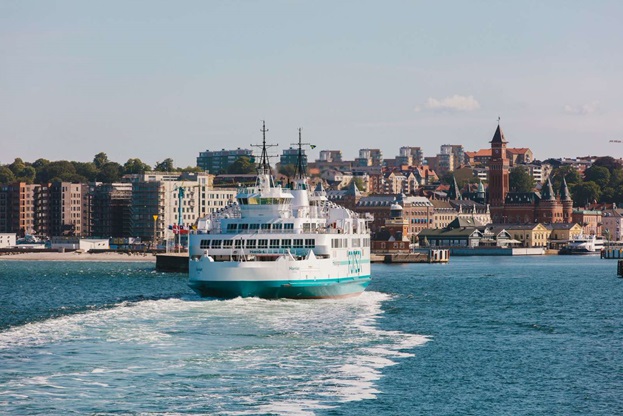
ForSea
The ferry company ForSea connects the two Scandinavian countries Sweden and Denmark by sea. Every day, their 4 ferries sail thousands of passengers across Øresund between Helsingborg and Helsingør.
The particle emission measurement was conducted on their diesel driven ferry, Hamlet, which runs on low sulfur marine oil with catalytic cleaning of the engine exhaust. ForSea also operates 2 battery driven ferries that both are class 5 vessels.
Visit ForSea:
https://www.forsea.dk/om-forsea/
Fairway fee and CSI
Merchant shipping vessels arriving to Swedish Ports must pay a fairway fee to the Swedish Maritime Administration Authority. The majority of the fees are related to transported goods and passengers. However, a part of the fees is environmentally differentiated into five different classes (1-5).
These classes depend on the verified scoring in accordance with the Clean Shipping Index (CSI) for each vessel. There are 5 categories in the Clean Shipping Index: SOx emission, NOx emission, CO2 emission, water and waste handling, and handling of chemicals.
The final score results in CSI Class 1-5 according to the below scheme:
- CSI Class 5: 125-150 points
- CSI Class 4: 100-124 points
- CSI Class 3: 75-99 points
- CSI Class 2: 38-74 points
- CSI Class 1: 0-37 points


Reach out to Frantz Bræstrup for more information.